
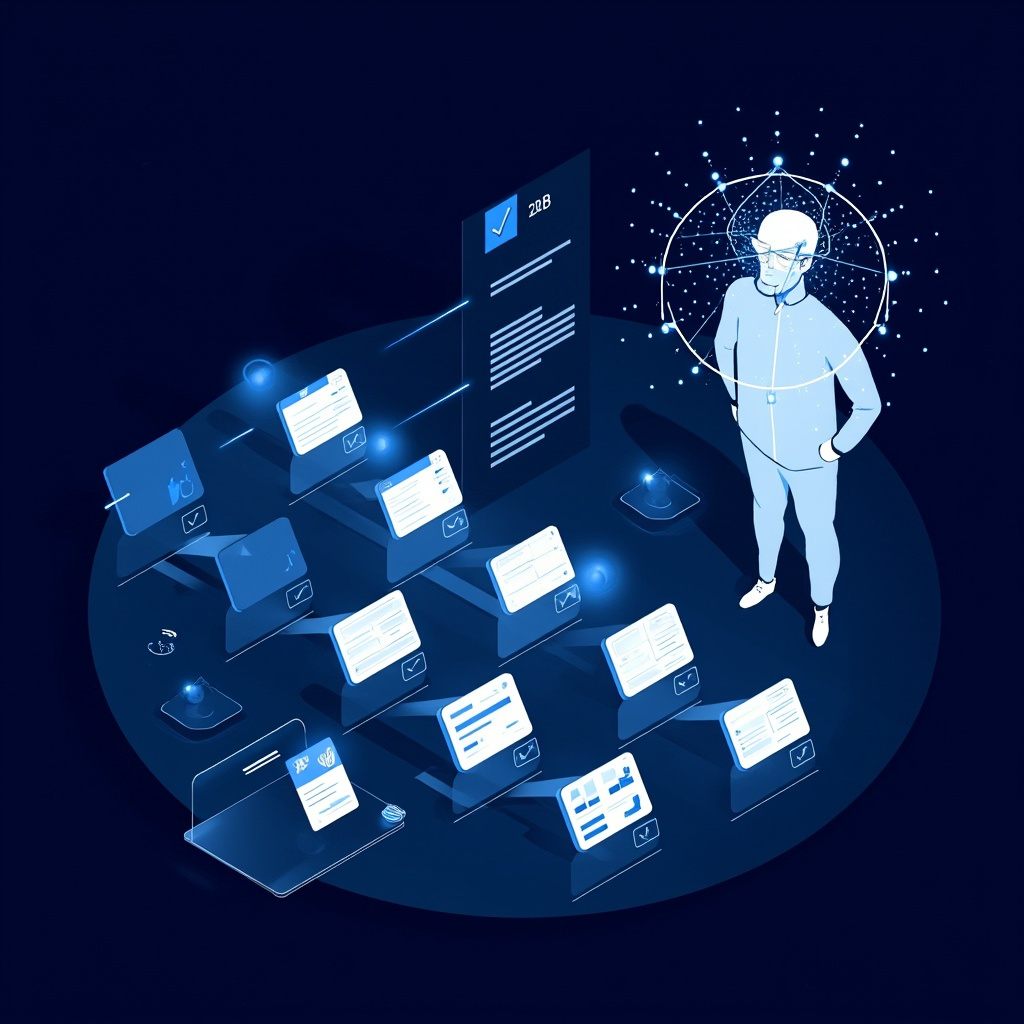
Your sales team just lost a deal they were certain they would win. The prospect’s website looked great. Their LinkedIn presence was active. They had three rounds of demos with your best AE. And yet, at the final stage, they went dark — then announced they had selected a vendor they found through an AI research agent they subscribed to six months ago. Nobody from your company ever spoke to that agent.
This is not a hypothetical anymore. It is the new normal in B2B buying.
The Scale of the Shift Is Larger Than Most Marketers Think
McKinsey’s 2026 B2B Pulse Survey — covering nearly 4,000 buyers and sellers across 13 countries — found something that should concentrate every CMO’s attention: the gap between B2B growth champions and laggards is widening at an accelerating rate, and AI is the primary differentiator. Not AI as a tool sitting on someone’s desk, but AI as an active economic actor in the buying process.
MartechMarkets.com’s analysis of the 2026 B2B buyer journey puts it more bluntly: the modern B2B buyer journey is no longer linear, observable, or brand-controlled. AI now shapes what prospects see, how information is prioritized, and which brands enter early consideration. Discovery increasingly unfolds inside algorithmically curated environments where probability — not funnel logic — determines visibility.
Think about what that means for your pipeline data. If a buying committee of five humans was replaced by one human plus three AI agents doing initial research and filtering, your attribution model is broken. Your win/loss analysis is incomplete. Your SDRs are talking to the survivors of a filtering process they cannot see.
What the Agentic Buyer Actually Does
The AI agents active in B2B buying are not science fiction. They are products available today: ChatGPT with memory and web browsing, Perplexity Enterprise, Microsoft Copilot agents, custom-built procurement assistants at larger enterprises. These agents are given budgets, mandates, and evaluation criteria. They research. They shortlist. They schedule demos. In some categories, they complete purchase orders.
Here is what their work looks like in practice: an AI agent tasked with evaluating marketing automation platforms will read your documentation, scrape your pricing page, analyze your public case studies, compare you against competitors on public benchmarks, and present a ranked shortlist to the human decision-maker — who often trusts the agent’s judgment because the agent synthesized more options than a human team could physically review.
The human’s role shifts from researcher to approver. And the approver’s default position is to trust the shortlist they did not build.
For B2B marketers, this creates an uncomfortable strategic inversion: your real audience is no longer the humans in the buying committee. It is the agent that decides which vendors reach the committee at all.
The Content Strategy Rewrites
If agents are doing the initial filtering, your content strategy needs to answer a different question. The old question was: how do we create content that resonates with the human buyer? The new question is: how do we create content that agents can find, understand, and use to evaluate us accurately?
This sounds like SEO, but it is more fundamental. Agents are not scanning for keywords — they are reading for structured meaning. Your pricing page, your case studies, your documentation, your API specs, your security whitepaper: these are not marketing collateral anymore. They are your product’s profile in an agent’s memory. If that profile is incomplete, contradictory, or optimized purely for human persuasion rather than accurate representation, the agent will evaluate you based on your worst content.
Your documentation is now demand generation. Not the blog post, not the webinar — the product docs. If your documentation is scattered, incomplete, or written in a style that obscures rather than clarifies, agents working on behalf of buyers will penalize you for it.
Case studies need to be agent-readable. Structured outcomes — quantified improvements in specific contexts — carry more weight than narrative storytelling when an agent is processing dozens of case studies in parallel. The story still matters for the human approver. But it is the structured data underneath that gets you on the shortlist.
Your G2 and TrustRadius profiles matter more than your own website. Third-party review platforms are where many AI agents do their initial competitive comparison. A sparse G2 profile with one generic review is worse than no profile at all — it gives the agent something to cite that contains almost no useful signal.
The Attribution Breakdown
Traditional B2B attribution breaks down when the buying process includes agents you cannot see. If an AI assistant recommended your product and the buyer acted on that recommendation without ever visiting your website, your attribution model credits nothing to organic search, nothing to paid, nothing to content. The AI agent is your new channel — and it is not tracked by any of your existing tools.
This is why the marketing ops teams that are furthest ahead on agentic buying are building something new: a shadow attribution layer that estimates the role AI agents played in pipeline, based on behavioral signals in their own networks and post-mortem loss surveys that specifically ask buyers about agent involvement.
Early data from organizations running this kind of analysis suggests AI agents are present in somewhere between 30% and 60% of B2B buying processes in mid-market and enterprise — with the higher end in technology and software categories where the agents are most capable and buyers are most comfortable delegating research.
The Sales Process Has a New First Step
If agents are doing the initial filtering, your sales process has a new first step: getting past the agent. Not the buyer — the agent.
This does not mean sales needs to become a black hat SEO game. It means the signals that make a vendor credible to an AI agent are similar to the signals that make a vendor credible to a skeptical human buyer: clear positioning, quantified outcomes, social proof from recognizable customers, consistent documentation, and competitive differentiation that can be stated directly rather than implied through narrative.
The companies adapting fastest are treating their first contact with a buying committee as the end of a process, not the beginning. They are building the informational foundation that makes an AI agent’s evaluation accurate — and favorable — before any human from the buying side has started paying attention.
What to Do About It Now
You are probably not going to build an agent strategy overnight. But there are three things you can start doing this quarter that move the needle:
First, audit your information architecture from an agent’s perspective. Pick an AI agent — any publicly available one — and use it to research your category and your company the way a buyer would. Note what it finds, what it cannot find, what it gets wrong, and what it correctly identifies as your differentiators. That audit tells you where your information is incomplete or misleading to machines.
Second, update your case studies and third-party profiles with structured, quantified outcomes. Agentic systems process structured data more reliably than narrative prose. The case study that reads well to a human buyer is valuable. The underlying data — industry, company size, outcome metric, time period — is what the agent uses to compare you against alternatives.
Third, instrument your post-mortems to ask about agent involvement. When you lose a deal, ask: did an AI agent play any role in evaluating vendors for this purchase? You will not get honest answers every time, but the data you gather over even a handful of deals will dramatically improve your ability to estimate how the agentic channel is affecting your pipeline.
The Bottom Line
The B2B buyer journey has always had hidden steps — the informal conversations in hallways, the analyst briefings before formal RFPs, the peer references that happen off-channel. The agentic buyer adds another hidden layer, but it is a layer you can understand and influence — if you think about it systematically rather than treating it as an abstract threat to your pipeline.
The organizations that will win in this environment are not the ones with the biggest marketing budgets. They are the ones whose informational presence is most complete, most accurate, and most structured — the ones that give AI agents the best possible evidence to include them in the shortlist.
In a buying environment where the agent acts as both researcher and filter, credibility is no longer just a human perception problem. It is a data problem. And data problems have solutions.